
Paul H. · November 4, 2026
Fix or Rebuild Your Vibe-Coded App? A Founder's Cost Math
Your Lovable, Bolt, or Cursor app is a mess and someone told you to start over. For most founders that is the expensive answer. Here is the math in developer-days, and the few cases where a rebuild is right.
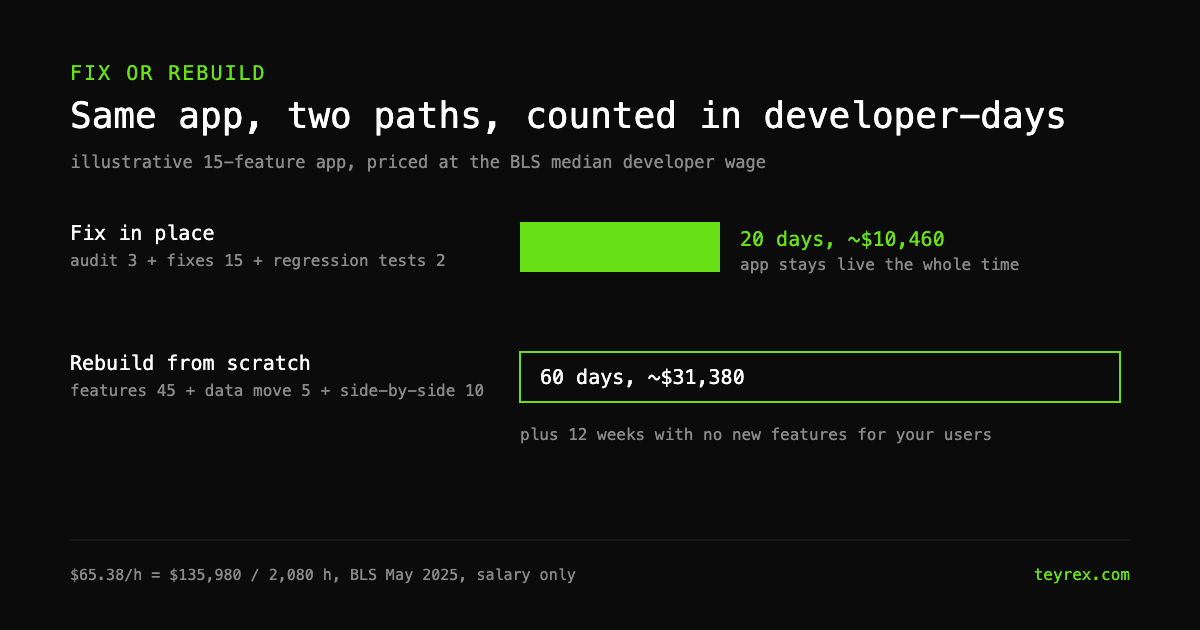
Short answer for founders: if your vibe-coded app has real users and its data model fits your business, fix it in place. In our worked example, fixing costs about 20 developer-days and a rebuild about 60, plus 12 weeks in which your users get nothing new. Rebuild only when there are no users yet, when the data model is wrong for the business, or when the stack cannot meet a hard requirement, and even then replace the app in parts. Messy code alone is never the reason.
This is written for non-technical founders and small teams who built with Lovable, Bolt, Cursor, or a similar tool and are now hearing opposite advice from two developers.
- Count in developer-days, not opinions. A rebuild repeats every feature you already have, then adds a data migration and a period of running both versions side by side.
- The database decides. Untangling code is work that happens screen by screen. Changing what your data means touches everything.
- A rebuild with the same habits rebuilds the same problems. If nothing changes in how code gets reviewed and tested, version two drifts the same way.
- Before either path, export your code to GitHub and back up your database. Both take minutes.
Why does every developer you talk to say rebuild?
Because a rebuild is easier to quote and nicer to work on. Reading someone else's generated code is slow, and starting fresh feels clean. Writing about Netscape in 2000, Joel Spolsky called a rewrite from scratch the single worst strategic mistake a software company can make. The reasoning holds for a 2026 prototype: the old code is ugly partly because it contains fixes for problems you already hit, and a rebuild throws those fixes away along with the mess.
A vibe-coded app adds a twist. The AI tool wrote it in weeks, so a rebuild sounds small. But the weeks you spent prompting were also weeks of you deciding how the product should behave. A developer rebuilding it has to rediscover each of those decisions from the running app, with no spec to read.
What does each path cost in developer-days?
Here is a worked example. It is illustrative, not a client case: a Lovable or Bolt app with 15 features (sign-up, a dashboard, billing, an admin page, and so on), a Supabase database, and a few hundred real users.
Fixing in place takes about 20 developer-days: 3 for an audit that finds and ranks the problems, 15 to fix them in priority order with security first, and 2 to add regression tests around the parts that broke. The app stays live the whole time, and users see it get more reliable week by week.
Rebuilding takes about 60: 45 to rebuild 15 features at 3 days each, 5 to move existing users and records into the new database, and 10 to run both versions side by side until the new one matches. For those 12 weeks, nothing new reaches your users, or you build every new feature twice.
To turn days into money with a neutral number, we used the US Bureau of Labor Statistics median annual wage for software developers: $135,980 in May 2025, or $65.38 an hour over 2,080 working hours (BLS page checked 2026-11-04). At that rate the fix is about $10,460 and the rebuild about $31,380. That is salary only, before benefits, hiring time, or agency margin, so real quotes for both paths will be higher. The ratio is the point: in this example the rebuild is 3 times the work, and it delivers an app your users already have.
For reference, our own prices: a fixed-price rescue audit starts at $1,400 with a report from 3 days, and full remediation typically runs $10,000 to $40,000, usually 2 to 4 weeks for apps under 50,000 lines of code.
When is a rebuild the right call?
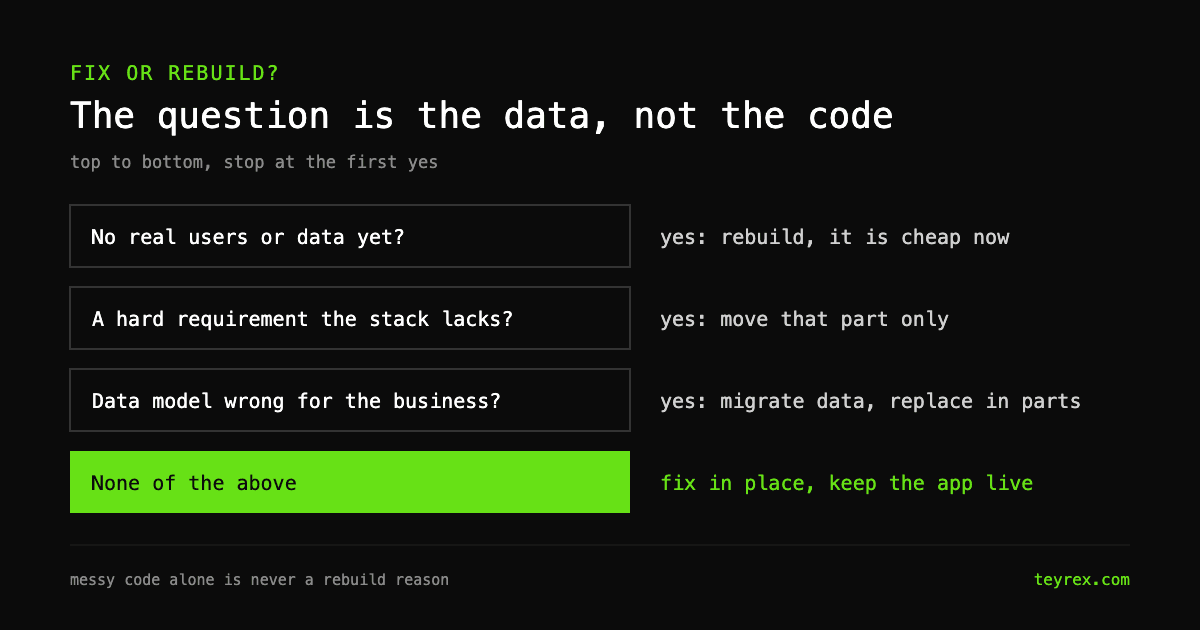
Rarely. Each of the cases below is about the data or the platform, not about how the code looks.
- There are no real users or data yet. If the app is a demo with a handful of screens and nobody depends on it, rebuilding is cheap and you lose nothing. This is the one case where starting over is the fast path.
- The data model is wrong for the business. Example: every record belongs to one user, but you now sell to teams that share an account. That change touches most tables and every access rule. Even then, move the data once and replace the app in parts rather than all at once.
- The stack cannot meet a hard requirement. Offline mobile use, hosting in a specific country for a regulated customer, or a load the current setup cannot carry. Move the part that needs it and keep the rest.
Notice what is missing from that list: tangled components, duplicated logic, no tests, inconsistent styling, secret keys in the wrong place. Those are normal findings in an AI-built app, and every one of them is fixable where it sits.
What does replacing an app in parts look like?
Martin Fowler calls it the strangler fig pattern: the new system grows around the old one and takes over one piece at a time, until the old one can be switched off. For a founder's app, that means login moves first, then billing, then each screen, while customers keep using the product. Fowler's argument is that the gradual approach lowers risk and returns value earlier, even though some temporary code gets written so old and new can run together.
For a Lovable or Bolt app, the database usually stays where it is. Supabase keeps working as the backend while the front end is cleaned up or replaced. The one thing that must be right before anything moves is access control: Supabase's own docs say to enable Row Level Security on every table in an exposed schema, because a table without it is readable and writable by any role with a grant on it.
What should you do before deciding?
Two things, whichever path you pick. Neither needs a developer.
- Get the code out of the tool. Lovable can export and two-way sync your project with GitHub, which gives you a full copy you control and lets any developer read it. Do this first: nobody can assess code they cannot see.
- Back up the database. On Supabase, Pro plan projects keep 7 days of daily backups, and the docs recommend that free plan projects export their data regularly with the CLI and keep an off-site copy. If you are on the free plan, run that export today.
Then get an opinion from someone who reads the code before recommending anything. Our free Vibe Code Health Check gives a first signal. Our founder's guide to a broken Lovable app covers how to judge who you hire.
What if two developers still disagree?
Ask each of them for an estimate in developer-days, split into the same parts as the example above. A rebuild quote that leaves out the data migration or the side-by-side period is missing a quarter of its cost. If someone says rebuild before opening the repository, ask which of the cases above applies; if they cannot name one, the answer is to fix. For a neutral read, our Lovable rescue audit is fixed-price, ranks every finding by business impact, and the report is yours to take to any developer, including the one who said rebuild.