
Paul H. · September 23, 2026
Your Lovable App Broke. A Founder's Guide to Getting It Fixed
You built an app with Lovable, Bolt, or Cursor. It worked, people used it, and now something is wrong and you are afraid to touch it. Here are your real options, what each costs, and what to do tonight.
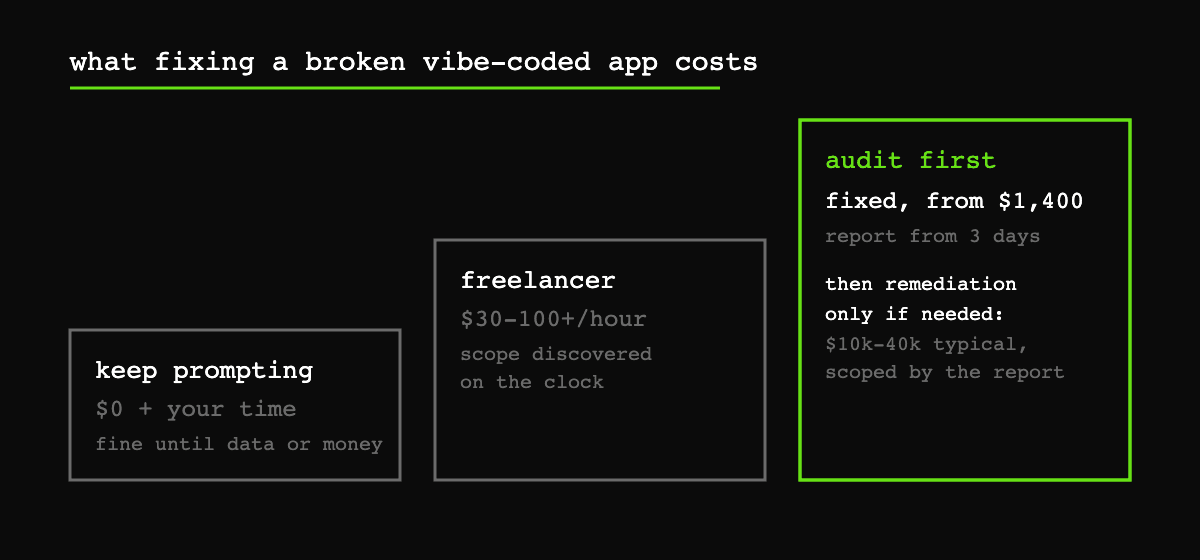
The short version: you have three realistic options. Keep prompting the AI to fix itself (free, works for small things, risky for anything touching data or payments), hire a freelancer (fast to start, quality is a lottery), or get a professional audit before anyone touches anything (we charge from $1,400, report from 3 days, and you can take the report anywhere). Which one is right depends on one question: is real user data or real money flowing through the app?
If the answer is yes, skip to the "do this tonight" section first. It takes twenty minutes and it protects you regardless of who ends up fixing the code.
First: this is normal, and your app is not garbage
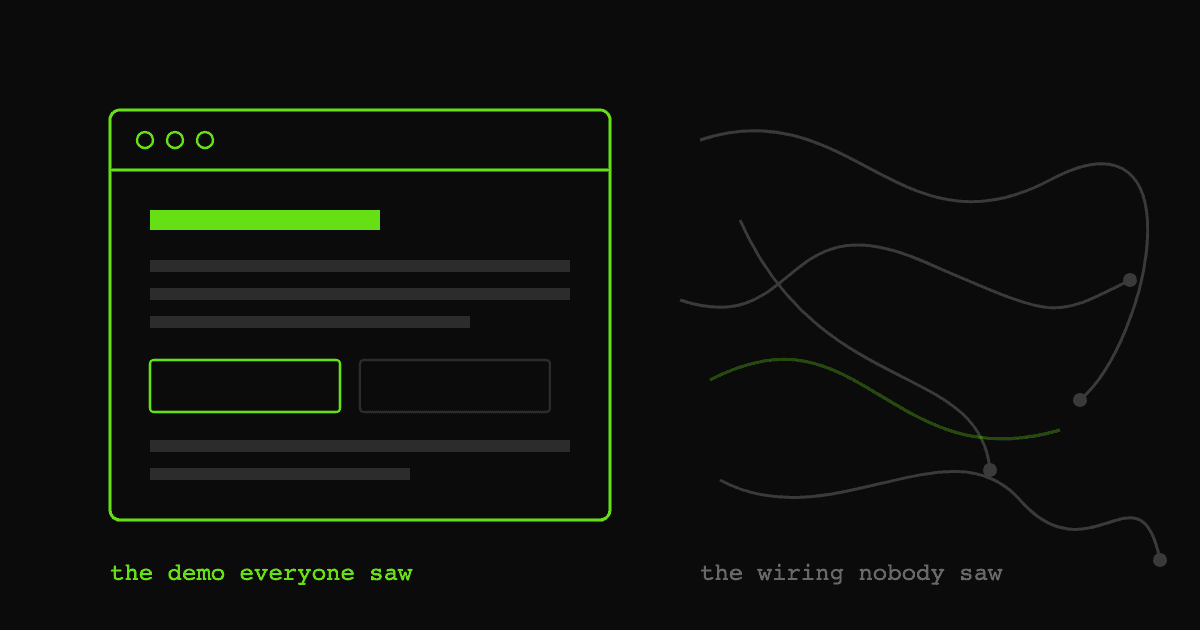
A working prototype with real users is a better starting position than 90% of software projects ever reach. You validated the idea without a team. The prototype did its job. What broke is not your idea, and usually not even one big bug. It is the accumulation of small decisions nobody made: the AI answered every prompt locally, and no one held the whole picture.
We audit these apps regularly, and the same patterns repeat: secrets sitting in client code, routes that never check who is asking, three different ways of loading the same data, and error handling that hides failures until they land in front of a customer. None of this is visible from the outside. All of it is findable, and most of it is fixable without a rewrite.
Your three options, honestly compared
Option 1: keep prompting. Cost: your time. For cosmetic bugs and copy changes, this is fine, keep doing it. The danger zone is anything involving login, payments, or user data: each new prompt patches the symptom and often adds another layer of inconsistency, and you cannot verify what it quietly changed elsewhere. If the app has real users, treat prompting as a way to build, not a way to repair.
Option 2: hire a freelancer. Cost: commonly $30-100+ per hour depending on region and seniority. Some are excellent. The structural problem: diagnosing an AI-generated codebase is archaeology, and hourly billing rewards slow archaeology. Without a fixed diagnosis first, you are paying someone to discover the scope of your problem on the clock.
Option 3: audit first, then decide. This is the sequence we recommend regardless of whether you hire us. A fixed-price audit (ours starts at $1,400 and the report arrives from 3 days) tells you what is actually broken, what is dangerous, and what a fix should cost. Full remediation, when needed, typically runs $10,000-40,000 depending on codebase size and severity. The audit report is yours: some founders take it and fix things themselves with the AI, which is a perfectly good outcome. You stop negotiating in the dark either way.
Do this tonight, before anyone touches the code
- Export your data. Whatever database the AI set up (usually Supabase or Firebase), find the export or backup button and use it. A broken app is recoverable; lost customer data is not.
- Rotate your API keys. If your app was built by AI, assume at least one key is exposed in the client code or the git history. Regenerate keys in each provider dashboard (Stripe, OpenAI, your database). GitHub's docs on removing exposed secrets explain why deleting the line is not enough.
- Stop deploying changes until you know what is wrong. The instinct to keep prompting fixes at midnight is how a broken feature becomes corrupted data.
- Write down what changed last. The prompt, the feature, the date. Whoever diagnoses the app will move twice as fast with this.
What a good rescue looks like (and the red flags)
Whoever you hire, the sequence should be: diagnose, stabilize, then improve. Security holes get closed before features get polished. You should get a written report of findings ranked by severity, most of which map to well-known categories like the OWASP Top 10. And the person should be able to explain every finding in plain language: if you cannot understand the diagnosis, you cannot judge the treatment.
- Red flag: "this all needs a rewrite" in the first conversation, before anyone has read the code. Sometimes true, rarely knowable that fast.
- Red flag: hourly work with no written diagnosis. You are funding open-ended exploration.
- Red flag: anyone who tells you to stop using AI tools entirely. The fix is guardrails, not abstinence. We use AI daily; the difference is typed interfaces, review on anything touching auth or payments, and CI that refuses to ship what does not build.
The decision in one paragraph
No real users or money yet: keep prompting, ship, learn, and add guardrails as you grow. Real users or revenue: protect the data tonight, then get a fixed-price diagnosis before committing to anyone's fix. If you want ours, the audit is from $1,400 with a report from 3 days, or start free with our code health checker to see which risk category your app falls into.