
Paul H. · November 17, 2026
What Does an AI Feature Cost Per User? A Founder's Token Math
An in-app AI assistant costs about $1 a month for a typical user and $11 for a heavy one on Claude Sonnet 5.5. Here is the per-user math with current prices, why 5% of users drive half the bill, and how to cap it.
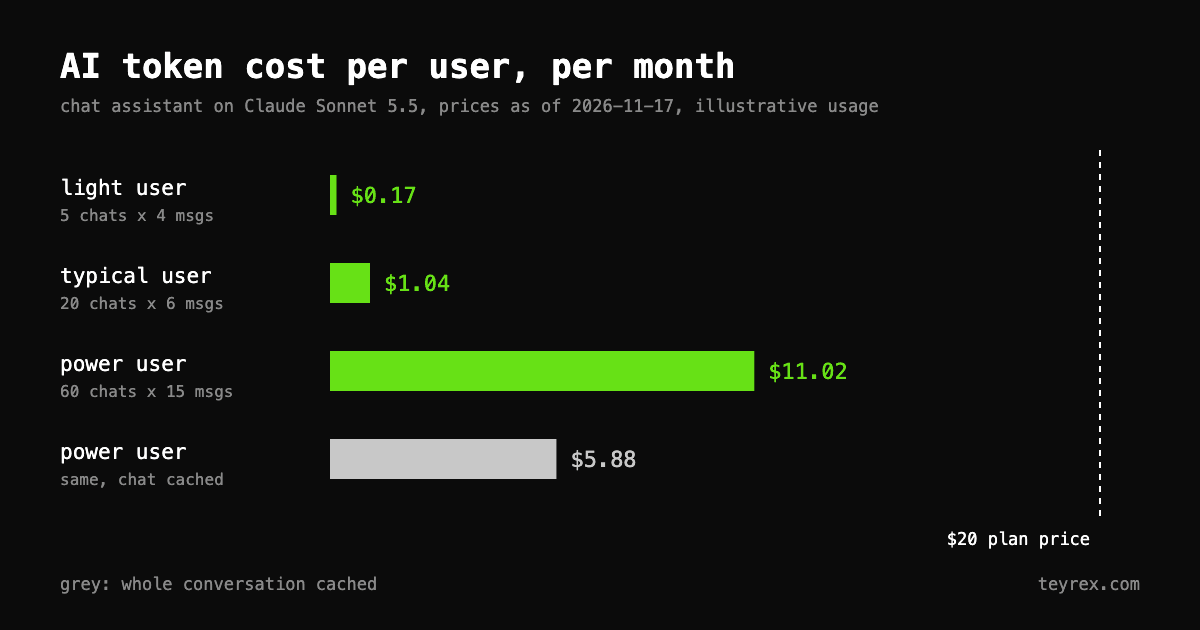
Short answer: an in-app AI assistant on Claude Sonnet 5.5 costs about $1 a month in tokens for a typical user and about $11 for a heavy user, at prices as of November 17, 2026. The average looks harmless. The problem is the spread. In our worked example, the heaviest 5% of users generate 54% of the token bill, and one of them on Opus 5.5 costs more than a $20 subscription brings in. Two changes bring it under control: cache the whole conversation and give every user a monthly token budget in your own code.
This is written for founders adding an AI feature to a product they charge for, usually a chat assistant built in Lovable, Cursor or Bolt on top of the Claude or OpenAI API. It is not about your own team's AI tools. It is about what each paying customer costs you when they press send.
- Price per user, not per message. A message costs about a cent. A user who sends 900 a month costs $11.
- Long chats cost more per message. Every message re-sends the whole conversation. Message 30 in a chat costs about 4 times as much as message 5.
- Caching the conversation cuts the heavy user's bill by 47%. It is a setting, not a rebuild.
- The provider will not cap individual users for you. API spend limits apply to your organization. A per-user budget has to live in your code.
What does one AI message cost?
One message in a typical assistant costs between half a cent and 3.5 cents on Claude Sonnet 5.5, depending on how long the conversation already is. As of November 17, 2026, Anthropic's pricing page lists Sonnet 5.5 at $2 per million input tokens and $10 per million output tokens. Cached input costs $0.10 per million to read and $2.50 per million to write. A token is roughly three quarters of a word.
Our worked example is illustrative, not a client case. Swap in your own numbers:
- Instructions and product context: 4,000 tokens sent with every message (system prompt, tool definitions, a few facts about the user's account).
- User message: 100 tokens.
- AI reply: 400 tokens.
- Caching: the 4,000-token instructions are cached; the conversation history is not. This is how many first versions ship.
With those numbers the first message of a chat costs 1.4 cents, mostly because the instructions get written to the cache. Message 5 costs 0.9 cents. Message 30 costs 3.4 cents, because by then it carries 14,500 tokens of earlier conversation billed at the full input price.
What does an AI feature cost per user per month?
Per user, the monthly cost ranges from 17 cents to $11 on Sonnet 5.5, and the range is the whole story. We split users into three usage patterns:
- Light user: 5 chats a month, 4 messages each. $0.17 a month.
- Typical user: 20 chats a month, 6 messages each. $1.04 a month.
- Power user: 60 chats a month, 15 messages each. $11.02 a month.
The power user sends 7.5 times as many messages as the typical user but costs 10.6 times as much, because their chats are longer. On a $20 plan, that one customer spends 55% of their subscription on tokens before you pay for hosting, payments or support.
Model choice moves these numbers more than anything else. The same power user costs $0.57 a month on Haiku 5.5 ($0.10 input, $0.50 output per million tokens for prompts up to 100,000 tokens) and $22.03 on Opus 5.5 ($4 and $20). On Opus, the heaviest customer on a $20 plan loses you money every month. Test the cheapest model that passes your own quality checks before you default to the biggest one.
Why do 5% of users drive half the bill?
Heavy users drive the bill because they send more messages and every one of those messages is longer to process. Take 1,000 users split 60% light, 35% typical and 5% power. Their monthly token bill on Sonnet 5.5 is about $1,018, or $1.02 per user. The 50 power users account for $551 of it, 54%.
This matters for pricing. If you set your plan price from the average of $1.02, you will be right on paper and wrong for the customers who love the feature most. They are also the users most likely to tell others about you, so blocking them outright is the wrong fix.
Why does a long chat cost more per message?
A long chat costs more per message because the model has no memory between requests. Anthropic's Messages API documentation says it plainly: the API is stateless, so your app sends the full conversation history every time. Message 30 pays for messages 1 through 29 again.
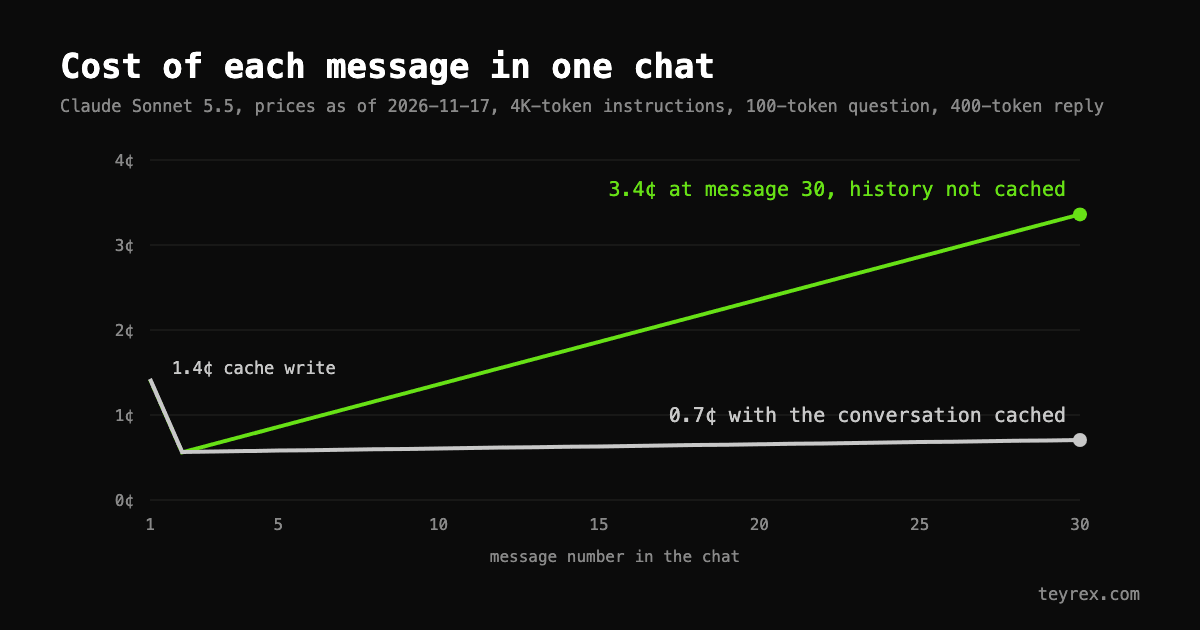
Without caching the history, cost per message climbs in a straight line, about 0.1 cents for every extra message in the chat. With the history cached, message 30 costs 0.7 cents instead of 3.4. Output tokens are the part caching cannot touch: the 400-token reply costs 0.4 cents every time.
How do you cut the per-user cost?
Two changes do most of the work: cache the whole conversation and set a monthly token budget for each user. Ranked by savings in our example:
- Cache the conversation, not only the instructions. With prompt caching applied to the growing message history, earlier turns are read at $0.10 per million instead of $2. The power user drops from $11.02 to $5.88 a month, the typical user from $1.04 to $0.86, and the 1,000-user bill from $1,018 to $690. Anthropic's automatic caching moves the cache point forward as the conversation grows. On Sonnet 5.5, Haiku 5.5 and Opus 5.5 a prompt must be at least 512 tokens to be cached.
- Give each user a monthly budget. Count tokens per user from the usage data each API response returns, store it next to the user record, and decide what happens at the limit: switch that user to a cheaper model, suggest starting a new chat, or offer a higher plan. Anthropic's spend limits apply to your organization and its workspaces, not to your individual customers, so this logic is yours to build.
- Pick the model per task. Short lookups and classification rarely need Sonnet. Routing them to Haiku 5.5 costs a twentieth as much per token.
- Trim the instructions. A 4,000-token system prompt that grew by copy and paste often works at half the size. Cached, it is cheap; uncached on every message, it adds up fast.
One caveat on caching: the cache lasts 5 minutes by default and resets each time it is used. A user who reads for 10 minutes before replying pays to write the cache again. Treat the cached figures above as the best case, and measure your real hit rate from the cache fields in each API response.
Another one on measuring: Claude 4.7 and later models use a newer tokenizer that produces about 30% more tokens for the same text. If you estimated token counts on an older model, add about 30% before trusting the totals.
How should you set a per-user token budget?
Set the budget as a share of what the user pays you, then check how many real users it would affect. A simple starting point is to cap AI cost at 25 to 30% of the plan price. On a $20 plan that is $5 to $6 a month. In our example a $6 budget covers every light and typical user, and a power user's whole month if conversations are cached ($5.88). Without caching, the same power user reaches $6 a little past the middle of the month.
- Log tokens per user from day one. Input, cached input, output and model, per request. Without this you are guessing from the monthly invoice.
- Look at the top 5% after the first month. Their cost per user, not the average, decides whether the plan price works.
- Set your organization spend limit at 2 to 3 times expected usage as a backstop against a bug or a leaked key, separate from the per-user budget.
For a first estimate before you have users, our AI cost estimator runs the same kind of math for your feature. The broader version of this argument, that every AI feature should earn back its token bill, is on our Return on Tokens page. If the feature is an agent that calls tools in a loop, the per-task numbers grow faster still; we priced that in are AI agents worth it for a small business.
If you want the caching, per-user budgets and model routing built into your product, that is part of our AI integration work. Basic integrations start at $5,000 to $15,000, and we size the token budget before we write the first prompt.