
Paul H. · October 27, 2026
Are AI Agents Worth It for a Small Business? The Per-Task Math
An AI agent picks its own steps, and it re-sends its whole history on every one. For a small business, that makes it 4 to 10 times the token cost of a fixed workflow. Here is when it still pays, with current prices.
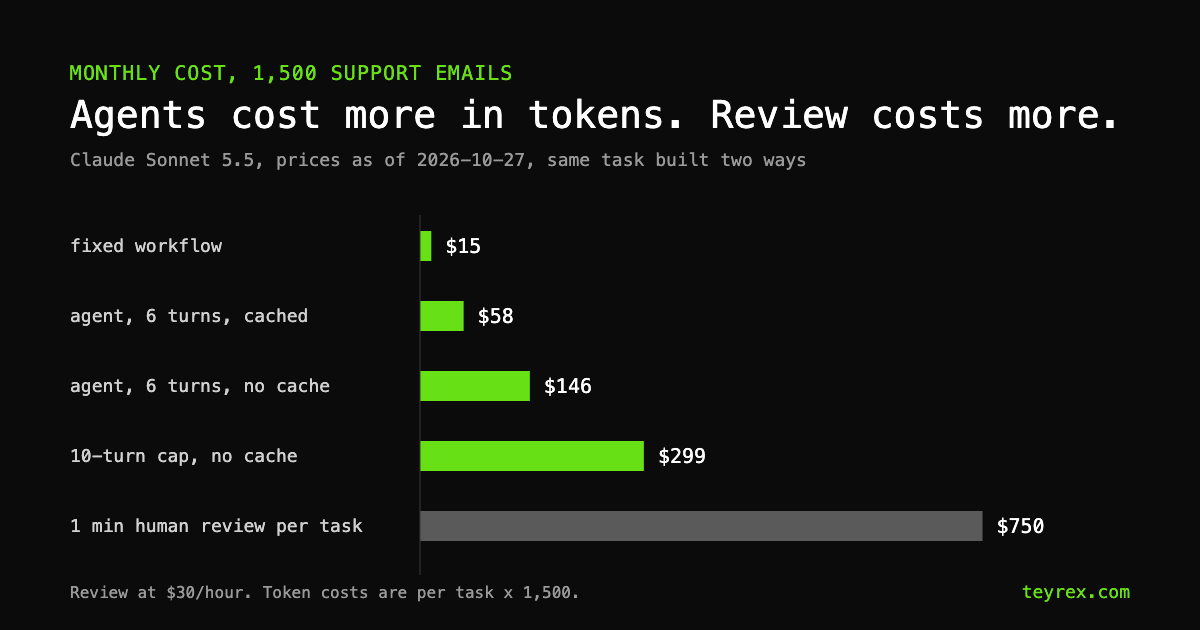
An AI agent is worth it for a small business only when the steps of the job cannot be written down in advance. If they can, build a fixed workflow where the AI handles one or two steps: you pay a fraction of the tokens and get more predictable results. In our worked example below, answering a support email costs about $0.01 as a workflow and $0.04 to $0.10 as an agent on Claude Sonnet 5.5. At 1,500 emails a month that is $15 against $58 to $146. Neither number decides the project. One minute of human checking per email costs $750 a month, and the agent is the version that needs more checking.
- The index card test. If you can list the steps on an index card, it is a workflow. Agents are for jobs where the next step depends on what the last one found.
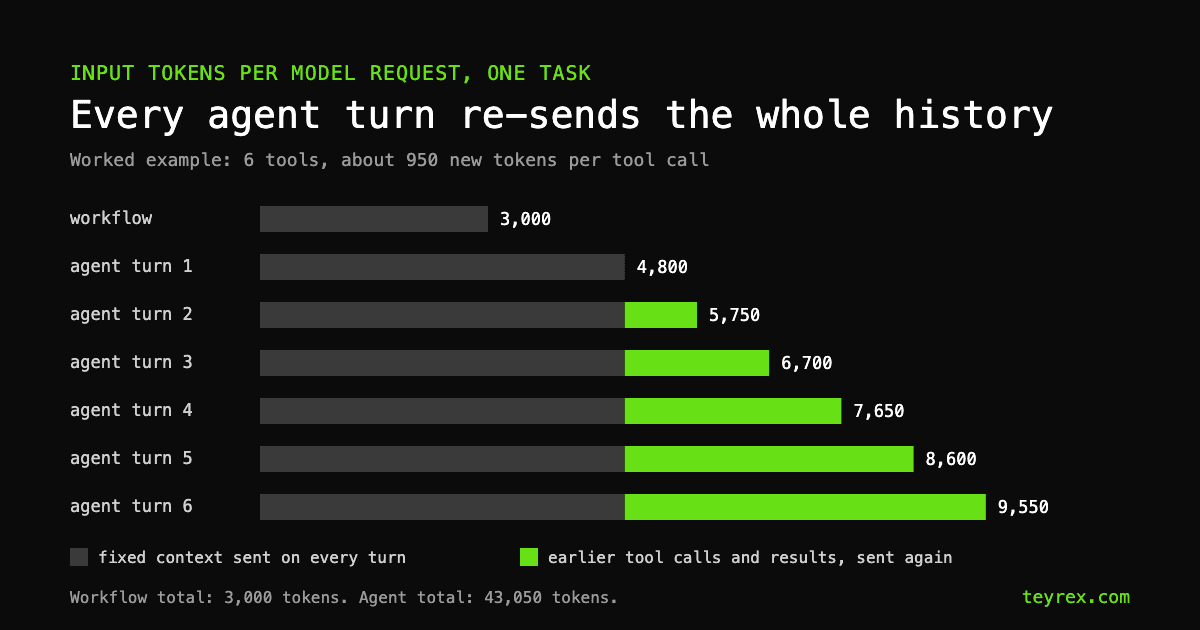
- Agents re-send their whole history on every turn, so token use grows with every tool call. In our example, a six-turn agent used 14 times the input tokens of the workflow.
- Caching cuts the agent bill by about 60%, and a cheaper model cuts it further: the same agent on Claude Haiku 5.5 costs about $3 to $7 a month.
- Cap every agent on turns and monthly spend, and put a person in front of anything that sends money or messages.
- All prices are Anthropic list prices as of 2026-10-27.
What is the difference between an AI agent and an AI workflow?
A workflow follows steps you wrote; an agent picks its own. That is the split Anthropic draws in Building effective agents: workflows run the model and tools through predefined code paths, while agents direct their own process and tool use. The same article advises finding the simplest solution possible and adding complexity only when needed, and it warns that agent autonomy brings higher costs and the potential for compounding errors.
In small business terms: an n8n workflow that fetches the order from your order system, then asks the model to draft a reply from the order and your refund policy, is a workflow. The n8n AI Agent node, given tools for order lookup, the refund policy, shipping status, and CRM notes, and told to handle the email, is an agent. Same model and data, different bill.
Why does an AI agent cost more per task?
Each tool call is a new request that carries everything before it. Anthropic's tool use docs describe the loop: the model asks for a tool, your code runs it, and you send a new request containing the original messages, the model's previous response, and the tool result. Tool definitions count as input tokens too, and whenever tools are present the API adds its own tool-use system prompt, 286 tokens on Sonnet 5.5 according to the pricing page.
Here is a worked example, not a client case. The workflow sends one 3,000-token prompt (instructions, refund policy, the email, and the order record an earlier step fetched) and gets back a 400-token draft. The agent starts with 4,800 tokens: the same instructions and policy plus six tool definitions and the email. It averages six turns, five tool calls of about 150 output tokens that each return about 800 tokens, then the 400-token draft. Each turn adds about 950 tokens of history, so its six requests carry 4,800, 5,750, 6,700, 7,650, 8,600, and 9,550 input tokens. That is 43,050 input tokens against the workflow's 3,000.
At Sonnet 5.5 list prices as of 2026-10-27, $2 per million input tokens and $10 per million output tokens:
- Workflow: $0.010 per email, $15 a month at 1,500 emails.
- Agent, no caching: $0.098 per email, $146 a month, about 10x the workflow.
- Agent with prompt caching: each turn reads the earlier turns back from cache at $0.10 per million tokens and writes only the new part at $2.50 per million. That is $0.039 per email, $58 a month, about 4x the workflow. Anthropic's prompt caching docs explain the mechanics.
- Agent that runs to a 10-turn cap, no caching: $0.199 per email. If every email went that way, $299 a month.
The model you choose moves the bill more than the architecture does. Claude Haiku 5.5 lists at $0.10 input and $0.50 output per million tokens for prompts up to 100,000 tokens, so the same six-turn agent costs about $0.005 per email: $7 a month uncached, about $3 cached. On Claude Opus 5.5, at $4 and $20, it is about $293 uncached. Test the cheap model first.
Is the token bill what makes an agent not worth it?
Usually not. Tokens are the small line. In our AI automation ROI worksheet, tokens came to about 0.5% of the monthly cost of a working automation, and the big lines were human review and fixing mistakes. Agents make those lines bigger.
A workflow does the same steps every time, so once you have checked 200 outputs you know what the next 1,000 look like, and you can drop review to a sample. An agent may take a different path on each email, so a clean week proves less about the next one. Errors also stack. If each of the agent's decisions is right 97% of the time, six in a row are all right only 83% of the time (0.97 to the sixth power). That is arithmetic, not a measured rate, but it is the shape of the compounding errors Anthropic warns about. If the agent version keeps a person checking every reply for one minute at $30 an hour, that costs $750 a month: five times the agent's uncached token bill and 50 times the workflow's.
When is an AI agent worth it for a small business?
An agent earns its cost when the job fits most of these conditions. If it fits none, build the workflow.
- The next step depends on what the last one found. Researching a lead across their website and your CRM, where each lookup decides the next, is agent work. Sending the same follow-up after every form submission is not.
- A wrong step is cheap and visible. Drafts a person approves and internal research notes are good fits. Refunds and emails to customers are not, unless a person approves each one.
- Volume is modest. At 50 tasks a week, the six-turn agent on Sonnet 5.5 costs under $25 a month in tokens even without caching, and a person can read every result. At 5,000 a week, every extra turn and every minute of review is real money.
- The agent is one step inside a workflow. The pattern we recommend first is a fixed workflow with one agent step for the messy part, such as sorting an unusual email, while the trigger and the actions stay fixed.
How do you stop an agent from running up the bill?
Set the limits before the first live run. Anthropic recommends extensive testing in sandboxed environments with appropriate guardrails. For a small business, that comes down to a handful of settings.
- Cap the turns. The n8n AI Agent node has a Max Iterations option, which defaults to 10 in n8n 2.44.7. Set it to the turns a normal task needs plus two, and log every run that hits the cap.
- Set a monthly spend limit in your model provider's console at two to three times expected usage, so a runaway loop stops at a number you chose.
- Approve irreversible actions. Let the agent draft the refund or the email, and let a person press send.
- Log turns and cost per task from day one. In the example, an average that creeps from six turns to nine raises the token bill by 75%, and nobody notices without the log.
- Cache the fixed part. The instructions and tool definitions are identical on every run, which is exactly what prompt caching is for.
What should you do before you build one?
Write the task's steps on an index card. If they fit and do not branch on what the AI finds, build a workflow. Our n8n team builds simple ones from about $5,000, and a workflow's failures are easier to catch. If the steps do vary, run the agent by hand on 20 real tasks first. Count the turns, multiply by the prices above, and add the review minutes. If the total still beats the hours it saves, build it; our Return on Tokens calculator does that last comparison. If you want a second opinion on which side of the line your project sits, our AI development team will tell you before you pay for either.